Welcome back to our Austin Robotics startup spotlight series.
As our community works together to build a world-class robotics ecosystem right here in Texas, one of the most critical challenges developers face is the "real-to-sim" gap. How do we ensure the robots we engineer in the lab actually succeed in the unpredictable environments of the real world?
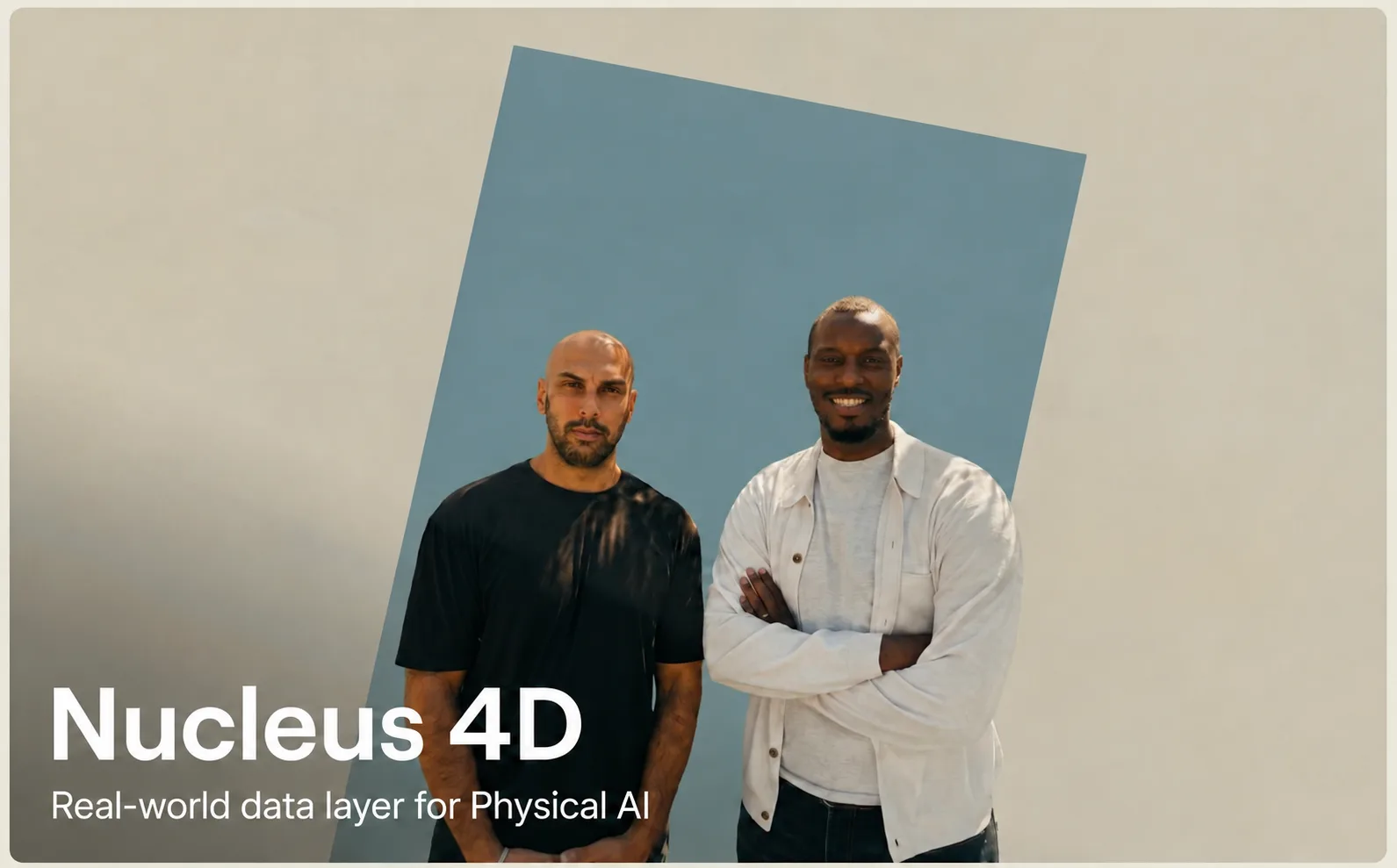
Enter Nucleus4D. Founded by Paulin Byusa and Navjeet Chhina, Nucleus4D is tackling this massive bottleneck by turning physical spaces into highly accurate, physically grounded simulation environments.
They are already partnering with UT Austin's NSF robotics center alongside industry leaders, providing the vital infrastructure spatial AI and robotics teams need to scale.
We caught up with the founders to learn more about their journey, their pivot into robotics, and how their technology is helping teams train the next generation of physical AI.
1. What inspired you to start your company, and what specific market gap does your solution address?
Our ambition is to make it easy to capture physical spaces and turn them into training data for spatial AI and simulation environments for robots. We started with real estate, hotels and venues, so people could tour a space without visiting in person.
As we looked for ways to scale, we explored early world models. We wanted anyone with an ordinary phone or camera to capture a space with limited input and still produce an accurate reconstruction. But the models we tried filled in missing information with hallucinations. A reconstruction could look convincing while getting the physical space wrong.
That experience showed us the value of what our capture operation was already producing: real imagery paired with measured geometry and explicit 3D data. Teams building spatial models and simulations need exactly that.
So we expanded into robotics, with a focus on closing the real-to-sim gap. Today, our scans train spatial models and become simulation environments where robots can practice in a digital twin of a real building before entering the actual one.
2. How did you determine that this was the right time to launch?
As robots move into industrial, commercial and home environments, teams need ways to train and test them in the environments where they'll actually work. Every building is different. A robot that succeeds in a lab can still struggle in an unfamiliar hallway.
We made an early bet that robotics teams would need real, diverse environments alongside human data.
Our existing business made that bet practical. We already had access to buildings and a global capture operation. That gave us a foundation to start supplying these environments early and expand as demand grows.
3. Who is your target audience, and which companies will benefit most from your product?
We serve AI labs building spatial and world models, and robotics teams that need real, diverse environments for training and testing.
For AI labs, we provide visual and spatial data tailored to their research needs, ranging from images and 360-degree captures to LiDAR point clouds and 3D geometry. For robotics teams, we turn captured spaces into simulation environments where they can train and test before deployment.
The strongest fit is a team looking for a library of physically grounded data and simulation-ready environments based on real spaces.
4. What is your current company status, and what are your immediate focus areas?
We're working with teams building spatial and world models, supplying physically grounded data captured from real environments.
We're also joining the NSF robotics center led by UT Austin as its real-to-sim scanning partner, alongside industry partners including Amazon, Apptronik and Google DeepMind.
Our immediate focus is rolling out a new capture product designed to 10x our data capture capacity.
5. Is there anything specific our community can help you with?
We'd welcome introductions to robotics, simulation and world-model teams looking for physically grounded data or simulation-ready environments.
If you have a facility you'd like scanned and made simulation-ready, we'd love to help.
6. What advice would you give to aspiring entrepreneurs in the robotics field?
Start with your customer's use case. "Simulation-ready" can mean very different things to different teams. A team testing navigation may need something quite different from one training a robot to manipulate objects.
Agree early on what the environment needs to support and how success will be measured. That clarity helps you prioritize what to build and deliver something the customer can actually use.
Founders
Paulin Byusa, Co-Founder & Chief Product Officer
Paulin leads product at Nucleus4D, turning real buildings into data that AI models and robots can learn from. He works directly with research labs and robotics teams on what their models and simulations need, and still joins captures himself, from NBA arenas to industrial facilities. Nucleus4D is his second company. He previously founded a crypto infrastructure company serving regional banks, and before that built payment products at Meta.
Navjeet Chhina, Co-Founder & CEO
Navjeet leads growth at Nucleus4D. He started his career in land development, where he developed and sold $200M in properties. He then built an agency that delivered $10M in 3D digital twins for Walmart, Gensler and other Fortune 500 companies. That mix of real estate access and 3D capture is the foundation of how Nucleus4D gets into buildings and scans them at scale.
Nucleus4D is in the Austin Robotics directory.