Welcome back to our Austin Robotics startup spotlight series.
This time we talked with Kimate Richards, founder and CEO of 10Things, about Aida, the wheeled robot 10Things is building for elder-care homes, the 10Things platform that takes robots from CAD and simulation to deployment, and what it takes to get a robot out of the lab.
1. After 30 years in robotics and leading Physical AI at AWS, what inspired you to start 10Things, and what problem between lab demos and real-world deployment are you solving?
Thirty years of integration work taught me one thing: the demo is never the hard part. I have watched robots perform flawlessly in a lab and then stall the moment they meet a different floor, a different light, or a different person. The policy did not get worse. The world got real.
At AWS, building out the physical AI team, I saw this same gap at fleet scale. Teams would spend a year getting a robot to work in one building and then discover they had no repeatable path to the second one. Every deployment was a heroic one-off, and heroics do not scale.
10Things exists to turn "leaving the lab" into an engineering discipline. We are contract-first, simulation-first, and governance-first, which means the robot you test is the robot you ship, and every skill it carries has a defined owner, a defined scope, and a defined way to roll back. Our tagline is literal: built for robots that need to leave the lab.
2. You are debuting Aida to help in elder-care homes. Why did you choose elder care and caregiver support as your first market?
Two things pulled me there. The first is math: care homes are chronically short-staffed, the people doing the work are burning out, and the shortage gets worse every year as the population ages. The second is something almost everyone has felt. If you have ever tried to find good care for a parent or grandparent, you know how hard it is to get consistent, quality care, and how much of that comes down to whether there are enough hands on the floor that day. Families feel it. Residents feel it. The staff feel it most.
That gap between the care people deserve and the care the system can deliver is a problem worth a career. And the work itself is a near-perfect fit for what a robot can do well today: fetching, carrying, restocking, delivering meals and water, moving linens, bringing the right thing to the right room. It is predictable, repeated hundreds of times a day, on flat indoor floors, on a schedule. Every one of those tasks Aida takes is time a caregiver gets back for the part of the job only a human can do, which is being present with a person.
The customer also measures value the right way. An operator does not ask whether Aida is impressive. They ask how many caregiver hours came back to residents. That is a number we can put on a contract, and it keeps us honest.
3. You often say that the first useful humanoids will have wheels. How did that belief shape Aida and your focus on repeatable daily tasks over flashy demos?
Legs are a research problem. Wheels are a product. The buildings where robots are needed first, care homes, hospitals, warehouses, are flat, indoor, and ADA-compliant. Wheels already won that environment decades ago, and no customer is paying a premium to watch a robot balance.
Putting Aida on a wheeled base with a vertical lift rail let me spend the engineering budget where the value is: the hands and the task. Aida has two 7-degree-of-freedom arms, PSYONIC Ability Hands with tactile sensing in every finger, and we are adding temperature sensing so the robot can tell what an object is made of and whether a container is full or empty. That is the hard, valuable part of care work, and it is where the money went.
The second thing the wheels belief gave me is a filter. A flashy demo is a video. A repeatable task is a contract. If a task does not happen every day, in every facility, in roughly the same way, it is not a task Aida needs to learn yet. We would rather do ten boring things reliably than one amazing thing once.
4. Aida is built to work alongside staff and hand off exceptions to humans. How do you design robots that earn trust and operate safely around people?
Trust comes from predictability first and capability second. Staff trust a robot they can anticipate. Aida is designed to do the boring 80 percent of a task and, when it hits something outside its scope, to stop, signal, and hand off to a person. It never improvises. A robot that guesses is a robot nobody wants in a hallway with residents.
The handoff is built into the architecture, not bolted on. Every skill Aida has is granted explicitly, as a combination of a person, a skill, and a specific robot body. If a skill misbehaves, we can roll it back to the previous known-good version. That is the same discipline you would expect from a bank's software, applied to a machine carrying a water pitcher.
On the sensing side, Aida knows when it does not know. Depth cameras in the head and chest, force sensors in the hands, and temperature sensing are fused together, so the robot is not acting on vision alone. If the hands say something different from the camera, that is an exception, and an exception goes to a human.
The last piece is people. We co-design the task list with the staff who will work next to the robot. The goal is for a caregiver to feel like Aida took the worst part of their shift, not their job.
5. Under the hood, the 10Things platform takes teams from CAD and simulation all the way to deployment. How does this software help both Aida and other robotics companies?
The platform is the set of tools I wished I had on every integration job for the last three decades. It is organized as six hubs that follow a robot's life: Discovery turns CAD into simulation-ready models (CAD to URDF to USD, with a physics classifier that decides how each part should behave). Control covers coaching, training, and teleoperation. CodeGen is an AI code factory for the glue nobody wants to write by hand. Interaction Builder is where workflows and the operator experience get built. Deployment handles fleets, CI/CD, and over-the-air updates. And a governance and admin layer sits across all of it, so every skill has an owner and an audit trail.
The loop we run is CAD to sim to real to sim to CAD to real. Something breaks on the floor, we reproduce it in simulation, fix the design or the policy, and ship the fix through the same pipeline. That is how you make deployment repeatable instead of heroic.
Aida is our proof. Every claim the platform makes has to survive a real robot in a real building, which keeps us from building tools that only work in slides. For other teams, the pitch is simple: you have a robot that works in the lab and a customer waiting. The platform gives you the path between those two points without rebuilding it yourself. It is built CLI-first and simulation-first on the NVIDIA Isaac and Omniverse stack, so it fits the tooling most serious teams already use.
6. Who is your ideal customer right now for both Aida pilots and the 10Things platform?
For Aida pilots, it is a care-home operator with a handful of facilities, an operations lead who is willing to co-design the task list with us, and a culture of measuring things. We are not looking for the biggest chain. We are looking for the partner who will tell us the truth about what worked on Tuesday night.
For the platform, it is a hardware team of five to fifty engineers who have a robot that works in the lab and a customer waiting on the other side. They have the robot. What they do not have is the pipeline from CAD to simulation to a fleet in the field, and they do not want to spend a year building one. Systems integrators who deploy other people's robots, including the Boston Dynamics ecosystem, are the second group, because governance and fleet tooling is the part of the job they get asked for and nobody hands them.
7. Where does the company stand today, and what is your main focus for the next year?
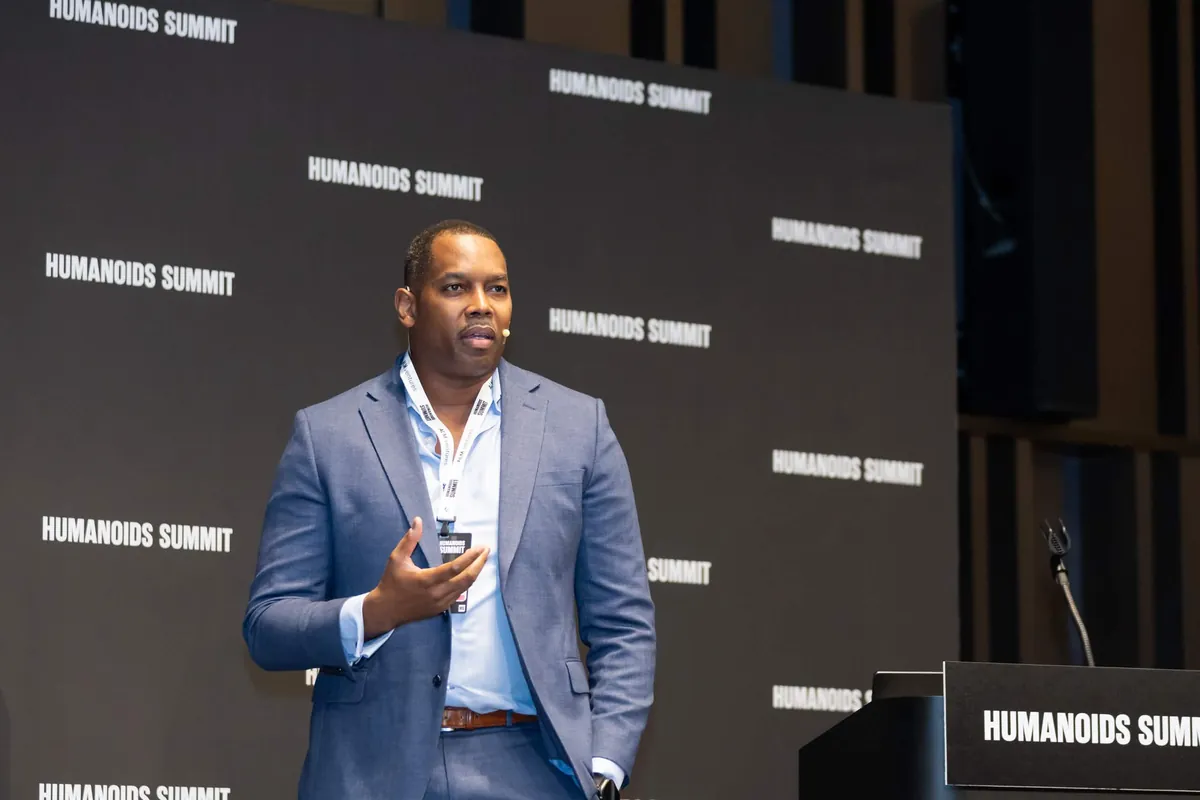
We're a small company with a lot of real engineering behind it. Across our three platforms we have over a million lines of tested code. Aida Core is in active development on the NVIDIA Isaac, GR00T, and Cosmos stack, and the hands are getting tactile and temperature sensing nobody else is shipping. I spent this fall showing that work at Humanoid Summit in Seoul and on NVIDIA's Omniverse livestream.
The next 90 days are about three things: funding, awareness, and infrastructure. On funding, I'll be candid: pilots cost money, and we need capital to run more of them. We've deliberately not raised on a flashy demo. I've watched too many robotics companies promise a video and spend three years building the product behind it. We'd rather show up with a robot that already does the boring tasks reliably and ask for the money to prove it on more floors.
After that, the goal is to fulfill our first orders with robots assembled and tested right here in Austin. Not a video, not a waitlist. Robots on a truck, going to a care home, built by people in this city.
8. You spend a lot of time mentoring student engineers. What is your best advice for builders in our community who want to launch their own robotics startup?
Build something that has to work for someone who does not care how it works. Your professor cares about your method. A night-shift nurse cares whether the thing showed up with the towels. Find that second person early and build for them.
Pick a task you can watch fail a hundred times. Robotics is learned in the failures, and a task you can only try twice a semester will not teach you anything. Cheap, repeatable, boring tasks are where you get good.
Learn the whole stack. CAD, simulation, control, deployment. Startups do not die inside a discipline; they die in the gaps between them, where the mechanical engineer and the software engineer each assumed the other had it covered.
And ship a boring thing before a cool thing. The cool thing gets you a video. The boring thing gets you a customer, and the customer is what makes the cool thing possible.
9. What is the most important thing someone needs to know before starting a robotics company to succeed at building an actual business?
Robotics is a services business wearing a product costume until you prove otherwise. Know who pays, what they measure, and how long it takes to get from a signed contract to a robot on their floor. Then double that last number.
The technology risk is almost never what kills a robotics company. The deployment cycle and the sales cycle are. A robot that works is table stakes. A robot that works in the customer's building, on their schedule, with their staff, inside their liability rules, is the business. Most founders spend 90 percent of their effort on the first and are surprised by the second.
So before you write a line of code, go sit in the building where your robot is supposed to work. Watch a shift. Find out what the people there would pay for, and what they would never let a robot near. That one day will save you a year.
10. How can the Austin Robotics community help you right now?
Three things. First, introductions: to investors who understand that robotics is a deployment business, and to elder-care operators in Central Texas who would host a pilot. Second, people: engineers who want to work on hands, tactile sensing, and real deployments, and students from ACC, where I once played a little basketball, and from our HBCU partners who want to build robots instead of reading about them. Third, infrastructure: shop space, assembly help, and local suppliers, because we intend to assemble and test these robots in Austin.
If you're reading this and any of that is you, email me at  or find me at 10things.tech.
10Things is in the Austin Robotics directory.
Watch Kimate
- Live @ The Robotics Watering Hole (YouTube livestream)
- Video to Data Challenge: From Human Video to Robot Skills (NVIDIA Omniverse on YouTube)